7 Ways to Shorten the Deal Cycle in Complex B2B Sales in 2025
A practical guide for accelerating enterprise deals with bigger buying committees. In 2025 the real competitor isn’t Gong, Salesforce, or the startup next door. It’s the silent 8-person buying committee that kills your deal without ever telling you why.
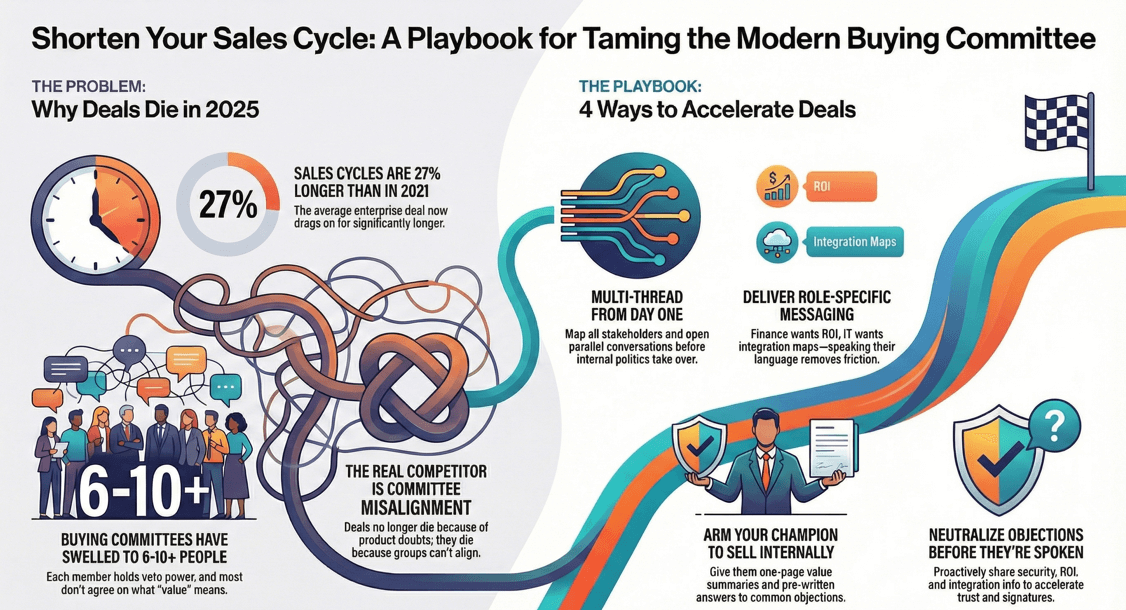
Deal cycles didn’t just stretch — they got heavier. Average enterprise sales now drag 27 % longer than in 2021, and the buying group sits at 6–10 people (sometimes 15+), and every one of them holds veto power. Most don’t know each other. Almost none agree on what “value” actually means.
Deals no longer die because of product doubts.
They die because groups can’t align.
Here are seven battle-tested ways to keep momentum when the committee is bigger than your champion ever warned you about.
1. Start Multi-Threading Early (Before Politics Take Over)
Most reps wait until the deal is already stuck. Then Legal panics, IT feels blindsided, and Finance asks “why am I only hearing this now?”
Too late.
Real top performers multi-thread the moment the first use case appears:
- Map every likely stakeholder immediately
- Open parallel conversations instead of betting on one champion
- Treat every new contact as a mini-committee member
One enterprise team we know cut average cycle time 38 % in a single quarter simply by moving multi-threading from stage 5 to stage 1.
2. Develop and Equip a Strong Internal Champion
In 2025 enthusiasm is table stakes.
The champion’s real job is to sell your deal inside their own company.
Give them weapons, not just motivation:
- One-page value summary
- Ready-to-forward messages tailored for IT, Finance, Legal
- A bullet-proof timeline they can defend
- Pre-written answers to the five objections they will definitely hear
Clarity beats passion every day of the week.
3. Deliver Role-Specific Messaging, Not a Uniform Narrative
Finance wants ROI.
IT wants integration maps and risk scores.
Legal wants liability capped.
Procurement wants predictable pricing.
End users want fewer clicks.
Send the same story to all of them and someone will block you — not because they hate the product, but because you ignored what they’re paid to protect.
Role-based messaging removes 20–30 % of friction almost overnight.
4. Anticipate and Neutralize Objections Upfront
Enterprise objections are as predictable as Monday mornings.
Top teams don’t wait to hear them — they kill them before they’re spoken:
- Security questionnaire attached on first discovery call
- ROI model delivered before Finance even asks
- Integration roadmap shared pre-emptively
- Ownership and success plan clarified in week two
Competence accelerates trust. Trust accelerates signatures.
5. Lighten the Load on the Buying Committee
Your stakeholders are drowning in tools, initiatives, and justification decks.
Your job is to be the one thing that feels easy.
Use:
- A one-page Decision Brief (yes, one page)
- Crystal-clear pricing table
- “What happens next” checklist
- 90-second video instead of 40-page PDF
The easier you make their life, the faster they sign.
6. Establish Routine Alignment Check-Ins
Complex deals don’t die from big objections.
They die in silence because nobody knows who’s doing what next.
Fix it with simple rituals:
- Weekly 3-bullet progress + risk email
- Shared mutual action plan with real dates
- Decision-owner map visible to everyone
- 15-minute cross-functional pulse calls
You don’t wait for alignment. You architect it.
7. Hone Behavioral Skills Through Sales Simulations
Process is important.
Prepared people are decisive.
Deals stall when reps freeze the first time Legal pushes back, when IT throws curveball questions, or when the champion asks “what do I tell Finance?”
These aren’t knowledge problems. They’re muscle-memory problems.
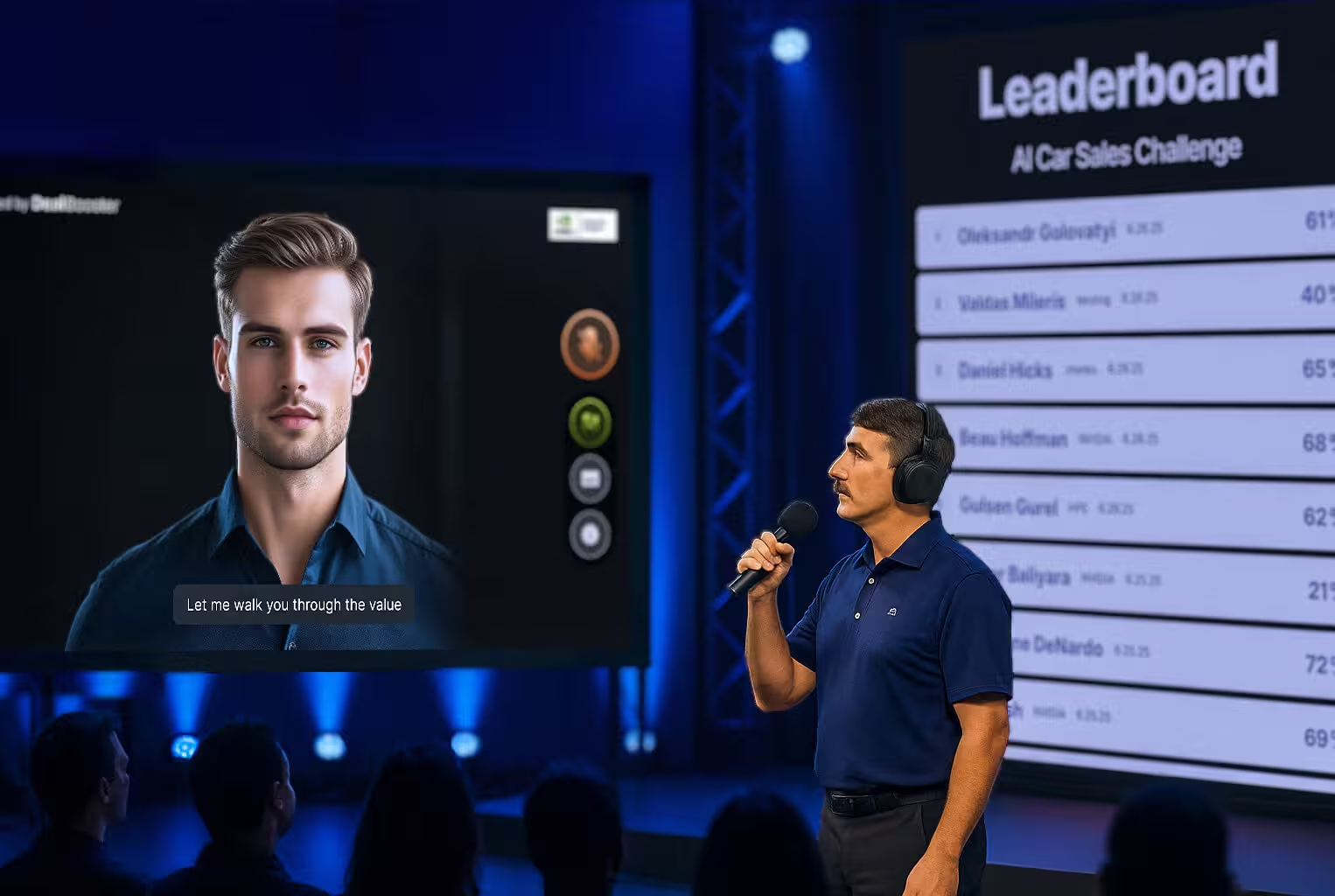
Modern sales simulations — including DealBooster — let reps rehearse exactly these moments:
- Live conversations with sceptical IT directors
- Conflicting priorities across eight stakeholders
- High-pressure objection chains
- Coaching champions through internal politics
Ten-fifteen realistic scenarios and your team walks into real deals calm, structured, and dangerously multi-thread-ready.
Behavioural readiness is the new unfair advantage in complex B2B.
Key Takeaways
Shortening cycles in 2025 isn’t about better decks or harder follow-ups.
It’s about repeatedly steering fragmented committees toward “yes” — at scale and without drama.
Teams that win consistently:
- Multi-thread from day one
- Arm champions like internal salespeople
- Speak each role’s language
- Kill objections before they’re born
- Make decisions feel effortless
- Force alignment through ritual
- Train behaviour, not just theory
Want to feel the difference yourself?
We can put you (or your team) through a 12-minute live multi-stakeholder simulation. No deck, no pitch, just the experience.
Most sales leaders who try it say the same thing: “I wish we had this two years ago.”
Request your simulation here.
FAQ: 5 Common Questions on Shortening B2B Cycles
Q1: Why are enterprise deals dragging longer?
A: Buying committees ballooned to 6–10+ people with conflicting priorities and veto rights.
Q2: What’s the quickest way to cut cycle time?
A: Early multi-threading + role-based messaging + proactive objection handling.
Q3: How do you keep a committee aligned?
A: Weekly recaps, visible mutual action plans, ownership maps, and short cross-team check-ins.
Q4: How should sellers support internal champions?
A: Give them reusable, role-specific materials and pre-written internal narratives.
Q5: Do sales simulations actually move the needle on real deals?
A: Yes — behavioural readiness is the strongest predictor of winning in complex environments.
Further Reading & Resources
Internal
- Modern sales simulations →
- AI-driven skill development →
- Role-play vs. traditional training →
- Enterprise case studies →
External
- Gartner B2B Buying Journey →
- McKinsey – The new B2B growth equation →
- Forrester – B2B buying study →
- HBR – Making the consensus sale →