What 2025 Exposed About Enterprise Sales Teams
Why tools got smarter - but deals didn’t get faster

In 2025, enterprise sales didn’t just slow down.
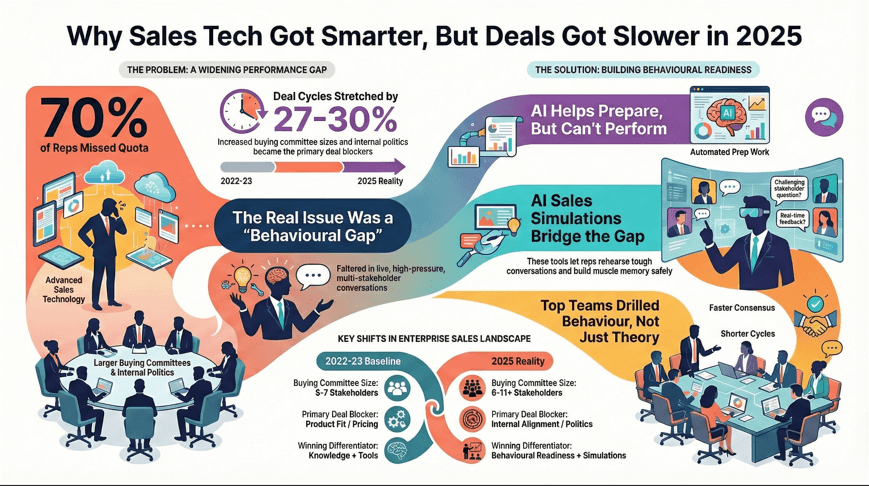
They became brutally unforgiving — and 70 % of reps still missed quota despite the most advanced stacks in history.
1. 2025 wasn’t a slow year. It was a revealing one
From the outside, 2025 looked like a triumph for sales tech.
AI copilots everywhere. CRMs predicting next steps. Analytics spotting risks weeks ahead. Pipelines gleaming.
Inside real enterprise teams, the story was different.
Average deal cycles stretched another 27–30 % year-over-year. Forecasts stayed shaky. High-intent deals vanished in silence.
2025 didn’t break enterprise sales.
It stripped away the illusions.
2. Tooling progressed faster than behaviour
Sales stacks hit peak sophistication.
Every email, call, and meeting tracked and scored. AI suggested perfect next moves.
Yet when reps faced live multi-stakeholder scrutiny, results still depended on one un-automatable factor:
How they handled real pressure in the moment.
Technology raced ahead.
Human execution couldn’t keep up — and the gap became glaring.
3. What actually slowed enterprise deals in 2025
Multiple forces hit at once:
- Buying committees grew to 6–11 stakeholders on average (up from 5–7 in 2022), with some deals involving 17+ people
- Risk aversion spiked across IT, finance, legal, and procurement
- Decisions went fully asynchronous and committee-driven
- Internal politics eclipsed product advantages
Deals didn’t collapse from poor fit.
They suffocated from lack of alignment.
4. Why classic sales playbooks stopped working
Tactics that once delivered consistent wins lost power fast.
Feature dumping bored buyers. Generic messaging got ignored by half the committee. Late-stage surprises killed momentum. Quarterly classroom training evaporated in real conversations.
The problem wasn’t outdated strategy.
It was zero tolerance for unpractised execution.
Traditional enablement bets on “learn now, apply later.”
2025 enterprise selling demanded flawless performance on the spot.
5. The real gap of 2025: behavioural readiness
The biggest challenges weren’t knowledge gaps.
Reps knew their solutions inside out. ICPs were clear. Battlecards were bookmarked.
They faltered in live behaviour under complexity:
- Keeping control when threads splintered across eight people
- Shifting tone and framing instantly per role
- Balancing conflicting priorities without dropping the ball
- Coaching champions through office politics
- Staying sharp when progress stalled for weeks
Behaviour decides enterprise wins.
And behaviour only improves through realistic repetition.
6. AI helped — but didn’t close the gap
AI became table stakes in 2025.
It crushed prep time. Personalised outreach at scale. Automated follow-ups. Surfaced hidden risks.
But AI couldn’t step into the conversation and perform when Legal pushed back hard or Finance went silent.
It made sellers smarter on paper.
It didn’t make them better in the fire.
7. Sales simulations filled the missing layer
This vacuum propelled one category forward in 2025: AI-driven sales simulations.
Not awkward classroom role-plays. Not static scripts.
Dynamic environments where reps rehearse full enterprise complexity before it costs quota.
Leading platforms put sellers through:
- Tough talks with Finance, IT, Legal, and Procurement personas
- Directly conflicting stakeholder demands
- Brutal objections followed by silence
- Decision paralysis and internal resistance
- Real-time champion coaching scenarios
Tools like DealBooster AI Sales Coach lead here — functioning as behavioural training grounds, not just analytics dashboards.
The edge is clear: reps build muscle memory on simulations, not on live million-dollar deals.
8. What adapting teams did differently
The teams that outperformed in 2025 didn’t buy more tools.
They changed how reps prepared.
They drilled behaviour over memorisation. Ran role-specific rehearsals weekly. Used simulations for ramping, promotions, and strategic accounts. Treated live deals as execution, not learning opportunities.
Outcome: faster consensus, fewer late surprises, and meaningfully shorter cycles.
9. Bottom line: 2025 rewarded readiness over knowledge
Enterprise sales didn’t get harder because buyers got pickier.
They got harder because there was no room left for on-the-job learning.
Winning belonged to teams that made behavioural readiness a core competency — right alongside pipeline hygiene and forecasting.
AI drove efficiency.
Sales simulations drove performance.
Platforms like DealBooster AI Sales Coach represent this pivot — moving teams from knowing the perfect line to delivering it when the deal hangs in the balance.
As we roll into 2026, the question isn’t whether your tech stack is modern.
It’s whether your reps are truly ready for the conversations that close enterprise deals.
Want to see the difference for yourself?
If longer cycles and missed forecasts hit close to home, the fastest way to evaluate this approach is to experience it.
Book a short demo to watch DealBooster AI Sales Coach recreate real multi-stakeholder dynamics — and see how leaders build behavioural readiness at scale.
→ Book a demo
Key 2025 Enterprise Sales Trends – Quick Overview Graphic
FAQ: Common Questions About Enterprise Sales in 2025
Q: Why did deal cycles get longer in 2025 despite better tools?
A: Buying committees expanded dramatically (6–11+ people), decisions became asynchronous, and internal alignment challenges overtook product concerns as the main stall factor.
Q: Did most sales reps hit quota in 2025?
A: No — roughly 70 % missed quota, even with advanced AI and analytics tools, highlighting the behavioural execution gap.
Q: What separated top-performing teams in 2025?
A: They prioritised behavioural readiness through realistic practice (e.g., sales simulations) over adding more knowledge-based tools.
Q: Can AI alone fix enterprise sales performance?
A: AI dramatically improved preparation and efficiency, but it couldn’t train reps to perform under real multi-stakeholder pressure.
Q: Are sales simulations worth implementing for 2026?
A: Yes — teams using modern simulation platforms reported faster consensus, fewer late-stage surprises, and shorter overall cycles by building muscle memory in safe environments.
Resources & Further Reading
- HubSpot — 2025 Sales Strategy Report — https://blog.hubspot.com/sales/hubspot-sales-strategy-report
- Gartner — B2B Buying Committees and Decision Complexity — https://www.gartner.com/en/sales/insights/b2b-buying-journey
- McKinsey — The New B2B Growth Equation — https://www.mckinsey.com/capabilities/growth-marketing-and-sales/our-insights/the-new-b2b-growth-equation
- Pipeline360 — The 2025 State of B2B Pipeline Growth — https://pipeline360.com/resources